
Historical Labor Organizing in Arizona

Arizona's Labor History, from 1846
It’s impossible to appreciate Arizona’s labor histories without some knowledge of the colonial and racial construction of the state.
After the US-Mexico War (1846-1848) and the Treaty of Mesilla (1854), the United States took over what we now know as the state of Arizona and had to confront governing sizable, diverse populations of Indigenous peoples and ethnic Mexicans. Historically, this has been a violent, asymmetrical process of restrictions, expulsions, and, occasionally, cooperation.
During times of economic prosperity, workers from different backgrounds have been encouraged to partake of robust demands for labor - historically, the jobs that helped build Arizona’s economic base were mining, agriculture, cattle, and railroads. From these times came policies like the Bracero Program or the Wheeler-Howard Act, both which were meant to grant some economic autonomy and opportunity to migrant and Indigenous workers during the Roosevelt administration, respectively.
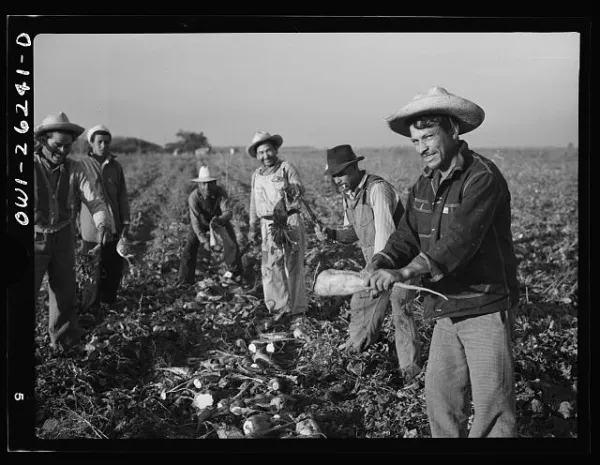
Non-white Workers Targeted, Punished in Times of Crisis
However, in times of economic crises, workers - especially non-white workers - have been blamed, maligned, and punished over perceptions of “taking jobs away” from white workers or otherwise benefitting, unfairly, from market forces or government policies. During these periods, there have been mass deportations and repressive policing against non-white populations, in general, and non-white workers who attempt to organize.
Structural acts like the “repatriation” of 1 million Mexican people during the Great Depression; or the violent response from Arizona Rangers to striking mine workers in Cananea, Sonora, Mexico in 1906; or the policy known as “outing” wherein Indigenous youth attending the Phoenix Indian School would be contracted out to mostly white families to work as housemaids or fieldhands in order to condition them to manual labor while also providing inexpensive workers for people of means.
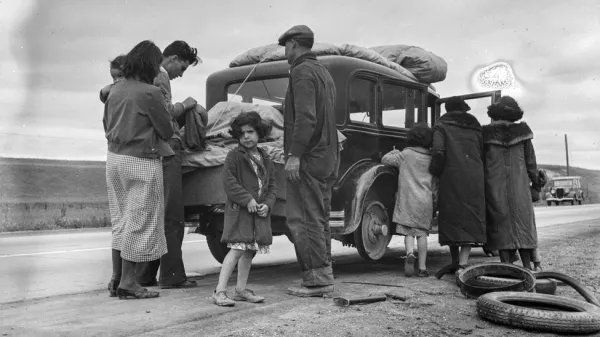
Differences in documentation status have also hindered prior labor organizing attempts in and around Arizona. United Farm Workers lead organizer and Arizona native Cesar E. Chavez once targeted undocumented workers as a source of labor weakness; echoing dehumanizing language, in 1973, Chavez and his union leaders embarked on a plan to identify undocumented farm workers and target them for deportation. The result was an overall weakening for all farm worker organizing, intensifying distrust among the ranks, and leaving the UFW leadership with little to show for their bigoted actions.
Multiracial Solidarity in Labor Organizing
There have also been moments of multiracial labor organizing for better worker policies. As historian Eric V. Meeks notes, the Arizona “right-to-work” law, originally passed in 1946, was a direct response to an organized multiracial miners' strike:
Between late March and July [of 1946], workers throughout Arizona, from all ethnic backgrounds, struck for higher wages. The Mine-Mill local at Clifton-Morenci, for example, known locally as the Mexican union, demanded equal wages and health benefits regardless of race. After holding out for 107 days, the union won an agreement with Phelps Dodge, ending the racially ordered wage system at least in its most blatant manifestation. Mexican-American workers successfully made use of their veteran status to convince enough Anglo workers of their worthiness for equal treatment, and as a result they won a substantial victory.
The 1946 strikes were pivotal in Arizona labor history, but opposing forces blunted their impact. Unionized mine workers faced entrenched opposition from the mining companies, the Arizona Farm Bureau, and government officials. In the midst of the 1946 victories, the state legislature passed a right-to-work law, which permitted nonunionized members to work in unionized mines and allowed unions from outside Arizona to challenge the authority of other democratically elected unions. Effective unionization and collective bargaining became more difficult. In response, ASFL [Arizona State Federation of Labor] organizers put aside their resentment toward the CIO [Congress of Industrial Organizations]-affiliated Mine-Mill to contest the measure. They described it as a “nefarious scheme” supported by “sweat shop [sic] employers” against “all liberty-loving citizens” and lobbied intensely to defeat it. In the end the bill passed over the protests of the unions. Just when the union movement was at its peak, it suffered one of its greatest blows (171).
When we work together, and when we’re mindful of the ways bosses and their allies exploit our differences to keep us divided, workers from all races, backgrounds, abilities, and cultures can do a lot. We can expose the alliances between greedy managers and paid political figures; we can recruit and partner with a larger, activated group of people; and we can win.
Join Your Union Today
For Further Reading
- Border Citizens: The Making of Indians, Mexicans, and Anglos in Arizona by Eric V. Meeks
- Migrant Imaginaries: Latino Cultural Politics in the U.S.-Mexico Borderlands by Alicia Schmidt Camacho
- Red Nation Rising: From Bordertown Violence to Native Liberation by Nick Estes, Melanie K. Yazzie, Jennifer Nez Denetdale, and David Correia
- Harvest of Empire: A History of Latinos in America by Juan Gonzalez
- Native Historians Write Back: Decolonizing American Indian History edited by Susan A. Miller and James Riding In
- Power Lines: Phoenix and the Making of the Modern Southwest by Andrew Needham
- Fragmented Lives, Assembled Parts: Culture, Capitalism, and Conquest at the U.S.-Mexico Border by Alejandro Lugo
- The U.S.-Mexico Transborder Region: Cultural Dynamics and Historical Interaction edited by Carlos G. Velez-Ibañez and Josiah Heyman
- Indian Given: Racial Geographies Across Mexico and the United States by Maria Josefina Saldaña-Portillo


How Will the University of Arizona's New Enrollment Policies Affect Learners & Workers?

We Joined the Arizona Right to Dissent Coalition